Ex. 1: HDL entry and simulation
Objectives
solve simple problem using HDL
register read / write
simple state machines
RTL simulation using QuestaSim
get an overview of the rvlab repository
Preparation
First of all it is necessary to get to know the overall Directory Structure of the RISC-V laboratory.
Make yourself familiar with the basics of the Design Flow Recipes.
If you haven’t used QuestaSim before read the QuestaSim Guide tutorial.
If you a new to System Verilog take part in the System Verilog crash course and study the “Verilog” section on the Resources page.
Blinkenlichten (start up project)
As an introductory project a simple running light (blinkenlichten) is to be designed and simulated which controls the eight LEDs connected to the FPGA.
Tasks
1. Develop a running light with the following functionality
Any LED pattern can be programmed into a pattern register
There should be four modes of the running light:
rotation left: The pattern is shifted left (in direction of the MSB, bit 7) every N clock cycles. The value of bit 7 is shifted to bit 0.
rotation right: The pattern is shifted right (in direction of the LSB, bit 0) every N clock cycles. The value of bit 0 is shifted to bit 7.
ping pong: The pattern is shifted left every N clock cycles until the initial value from bit 0 has reached bit 7. The values shifted beyond bit 7 are not copied to bit 0 but are preserved internally. After the value of bit 0 has reached bit 6 the direction is reversed. The bits previously shifted out appear successively at bit 7 until the original pattern is restored. Then the pattern is shifted further right until the original value of bit 7 has reached bit 0 upon which the direction is reversed again.
stop: The currently displayed pattern is kept.
N should be programmable with a register (Note: the FPGA internally operates with 60 MHz).
A status register reflects the current status of the LEDs
All registers must be readable by the CPU via the register bus.
A maximum of four 32bit addresses (relative addresses 0x0, 0x4, 0x8, 0xC) of the address space may be used to access the registers of the running light.
After a reset your running light should start in ping pong mode with a reasonable speed and pattern. In the final project this pattern is used to distinguish your project from the other projects when loaded into the FPGA.
Use the template rvlab/src/rtl/student/student_rlight.sv to implement your running light. It contains tul_adapter_reg converting TileLink Uncached Lightweight (TL-UL) to the register bus to be used by your code. Replace / modify the demo FSM and register read write processes to implement the running light.
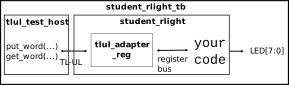
2. Simulate
Test your running light with the test bench rvlab/src/fv/student_rlight_tb.sv , which instantiates your running light and simulates TL-UL write accesses to your module.
Extend the test bench to cover the following functionality:
All registers should be read and written at least once.
All modes should be tested at least once
Check how the design behaves if the pattern or delay is changed during operation (i.e. delay changes from 10 to 20 to 8 cycles). At no time should a delay or pattern be displayed which has not been programmed.
To compile your design and invoke QuestaSim for simulation from the rvlab directory:
flow student_rlight_tb.sim_rtl_questa