Clocks and Resets
The following diagram gives an overview over the clocks that resets that are present in the system.
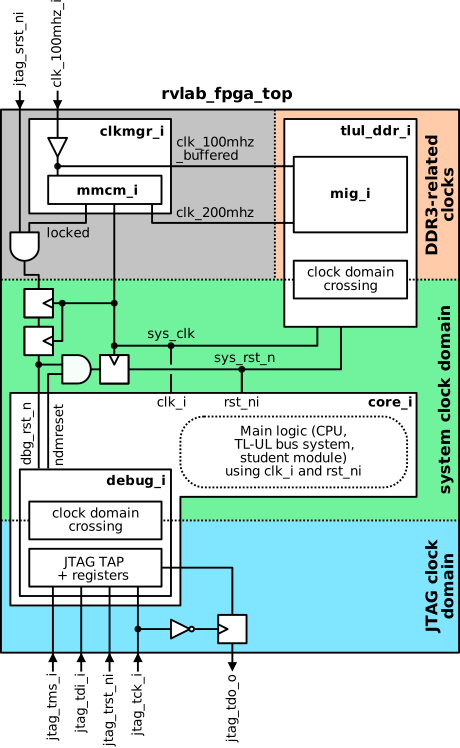
rvlab_fpga_top clock & reset diagram
The system’s main logic (CPU, TL-UL bus, student module) are clocked by the system clock (sys_clk connected to clk_i) and are reset asynchronously by the system reset (sys_rst_n connected to rst_ni). The system clock is generated by a on-chip multi-mode clock manager (MMCM) and has a frequency of 50 MHz.
The MMCM is driven by an external 100 MHz crystal oscillator.
The RISC-V debug logic can reset the system clock domain using its ndmreset signal (non-debug-module reset). The RISC-V debug logic itself is reset by a separate signal dbg_rst_n, excluding itself from such an ndmreset.
Bitstream loading initializes the synchronization flip-flops in the system clock domain with asserted reset signals. sys_rst_n and dbg_rst_n are deasserted when the external system-reset signal jtag_srst_ni is deasserted and the MMCM clocks are ready (locked). Strictly speaking, jtag_srst_ni is not a JTAG signal, but it is connected to the FT2232H chip that also drives the JTAG signals. The mechanical reset button is not connected to any reset.
Multi-FF Synchronizers
Synchronizer flip-flops at clock domain crossings should be marked with (* ASYNC_REG = "TRUE" *) in Verilog. This causes them to be treated differently during synthesis and simulation. Most importantly, timing violations at flip-flops marked as ASYNC_REG do not lead to X values in simulation. Vivado does this by setting the XON parameter of the flip-flop (e.g. FDCE) to FALSE. No additional XDC constations are needed. Details are described in UG912 (see Resources).
The setup/hold violations are still printed by the simulator, even though they do not result in X values.
The prim_flop_2sync module uses the ASYNC_TRUE property as described.